THE AMERICAN BOARD OF PATHOLOGY
Celebrating 90 Years of Advancing
the Profession of Pathology
1936 – 2026
In July 1936, the American Board of Pathology held its first official business meeting — marking the beginning of a shared commitment to advancing standards in pathology.
SERVING THE PUBLIC
Serving the Public, Advancing the Profession
ABPath’s mission is to serve the public and advance the profession of pathology by setting certification standards and promoting the lifelong competency of pathologists.
In July 1936, the American Board of Pathology held its first official business meeting, marking the beginning of a shared commitment to advancing standards in pathology. Later that year, ABPath administered its first certification examinations and certified its first 60 Diplomates. That commitment continues today through the work of pathologists, educators, volunteers, specialty societies, training programs, and other stakeholders dedicated to supporting excellence in the specialty.
Over the past 90 years, pathology and laboratory medicine have evolved dramatically, driven by scientific discoveries, technological advances, and new areas of specialization. What has remained constant is the profession’s commitment to maintaining high standards in support of quality patient care.
As the specialty has advanced, certification programs have evolved as well. New subspecialty certifications were introduced to reflect emerging areas of expertise. The Continuing Certification (CC) Program, formerly known as Maintenance of Certification (MOC), was implemented to maintain standards necessary to provide quality care throughout a physician’s career. Assessment methods progressed from written and oral examinations to computer-based testing and longitudinal assessment through ABPath CertLink®. Together, these programs support lifelong learning and professional development throughout a physician’s career
The work of advancing standards in pathology is made possible through the dedication of volunteers who contribute their time, expertise, and leadership in support of the profession. As ABPath marks its 90th anniversary, the milestone offers an opportunity to reflect on a longstanding commitment to serving the public, supporting the profession, and sustaining the trust that patients, health care organizations, and the public place in board-certified pathologists.
a look back
90 Years of Milestones
Key moments in the evolution of ABPath and its certification programs.
foundations
1936
Articles of Incorporation are signed and the American Board of Pathology holds its first official business meeting. ABPath administers its first certification examinations and certifies its first 60 Diplomates.
1948
Neuropathology becomes the first pathology subspecialty certification offered by ABPath.
expansion & Specialization
1950–1983
Additional subspecialty certifications are introduced, reflecting the growing complexity and specialization of pathology practice.
1995
ABPath administers the first computer-based examination.
continuing certification & the future
2006
ABPath launches its MOC program for maintaining certification and promoting lifelong learning, now known as the Continuing Certification Program.
2015
Certification transitions from a time-limited credential to a continuous certification model that emphasizes ongoing participation and professional development.
2021
ABPath implements the ABPath CertLink® platform to replace the traditional 10-year MOC/CC examination.
2025
ABPath publishes comprehensive Content Specifications to provide greater transparency regarding examination content and expectations.
2026
ABPath launches a competency-based assessment pilot and marks 90 years of advancing the profession of pathology.
Images from ABPath’s History
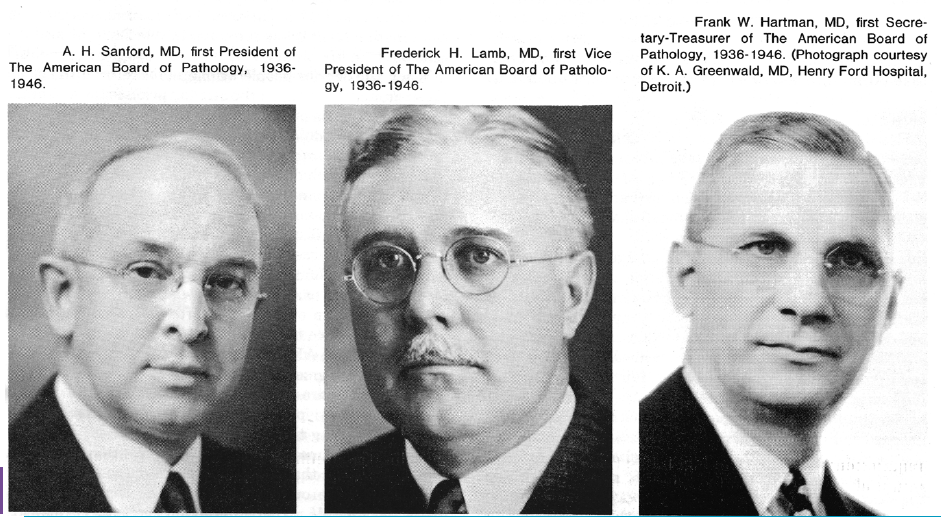
Original Trustees of the American Board of Pathology, 1936.
Certification examinations in an earlier era of ABPath’s history.

ABPath certification examinations evolved alongside advances in technology and assessment.

looking forward
Building on 90 Years of Progress
As pathology and laboratory medicine continue to evolve, ABPath remains committed to ensuring that its certification and assessment programs are meaningful, relevant, and reflective of today’s practice.
Building on its longstanding role in setting certification standards, ABPath is exploring new approaches to assessing the knowledge, skills, ability, and judgment that are essential to the practice of pathology. This work includes initiatives related to competency-based medical education, formative assessment, and the evaluation of innovative assessment methods that may help support trainees, residency programs, and future certification programs.
These efforts reflect ABPath’s commitment to continuous improvement and to working collaboratively with pathology educators, training programs, volunteers, specialty societies, and other stakeholders.
While assessment methods will continue to evolve, ABPath’s mission remains unchanged. As it has for the past 90 years, ABPath will continue to adapt its certification programs in support of high standards in pathology and quality patient care.